
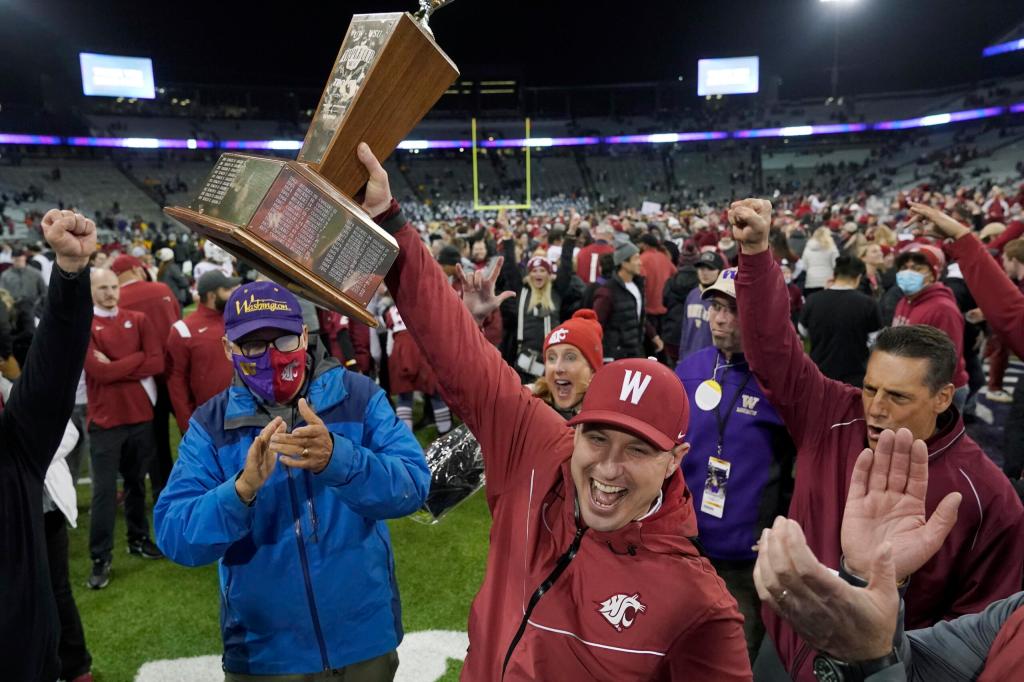
Well, happy college football season. I guess.
I feel like I’ve crossed into the Twilight Zone this past month or so. It’s been a topsy-turvy time, to say the least.
The 2024 college football season will feature a sixteen-team SEC and an eighteen-team BIG (they, uh, still gonna go by the Big Ten, huh?). The Big 12 will play as this weird, Frankensteined league that stretches across three time zones and groups together West Virginia and BYU. The ACC has one member basically in open rebellion and at least two more that are probably (definitely) looking for an escape hatch. For some reason we decided twelve playoff teams was the optimal number, despite it being (checks notes) not an exponent of two. And the Pac-12, a college football staple for as long as any of us have been alive, disintegrated from a golf course.
I’m not gonna mince words — this royally sucks. USC in the Big Ten sucks. Stanford in the ACC, while immensely funny, sucks. The death of two iconic in-state rivalries sucks. Leaving proud fanbases to fend for themselves in a system that doesn’t really allow for that sucks.
A twelve-team playoff sucks. Placing far more importance on conference title games than they merit sucks. Watering down the regular season sucks. Giving all the powerhouse programs two or three mulligans a year sucks.
Trying to turn one of the most unique sports in the world into a minor pro league sucks. An obsessive pursuit of dollars at the same time none of this money goes to the actual athletes playing these games sucks. Schools desparately trying to keep up in a comically pointless horse race sucks.
And yes, Texas and Oklahoma in the SEC sucks. This all sucks. It’s awful.
It’s become crystal clear that this season will be the last year college football looks like anything resembling the game I grew up with.
The media machine, coincidentally controlled by the very same people who need you to watch this new college football hydra to justify the billions they are pouring into it, has desperately tried to convince you that this is reasonable and good. College football lacks big games, they say. We need more marquee matchups, they say. They are lying to you. No, the decisions made over the last few years, and this summer especially, suggest the powers that be in college football fundamentally misunderstand their sport. Rather than embracing college football’s strengths, they’ve decided to run away from them, to paint a TV network-coated fig leaf over their weaknesses instead of working around them. As we’ll get into later, it’s not going to work.
Look, I’m on record multiple times as arguing college football’s inherent charm is its nonsense. But not this kind of nonsense. This is nonsense trying to make college football something it is not. This is nonsense directed at stripping away all of the weird, wild, and wonderful things about this bananas sport. Put far too cutely, it’s nonsense-eating nonsense.
No one really knows what the new college football will look like. No one knows what it will feel like. But we do know it won’t be the same.
The revolution is here. And goddamnit, it’ll be televised to hell and back.

Genuine question — and I promise I’m not being tongue-in-cheek here — does the Big Ten hate college football?
Let’s think about the history of the Big Ten for a second. Not only are they the oldest conference in the country (and conferences are what’s wrong the game), but the signature decisions made by the conference over it’s lifetime have suggested a deep-seated disdain for the sport they ostensibly exist to organize.
You don’t even have to look that far back — the Big Ten was the clubhouse leader among power conferences in cancelling the 2020 season, before the rest of the country showed that it was possible to play with reasonable safety protocols. Even then, it prevented students from attending games, jettisoning any lingering illusion that they care about the “college” part of college football.
And that’s not even getting into the fact that it prevented its teams from playing in bowl games other than the Rose Bowl for most of its history. That’s right, if you were a Big Ten member in, say, 1963, it was LA or bust for you, while a peer in the SEC or Big 8 could go to any bowl that would have them. The Big Ten literally thought its teams should play less college football for three-quarters of a century. Not only that, but the league implemented a ridiculous rule that, even if one of its members won the league championship in back-to-back years, it could not go to the Rose Bowl twice in a row. It purposely devalued its own championship.
In addition to all of that, they play Big Ten football. Only in the Big Ten could you have an offensive coordinator contractually obligated to score 25 points per game, could a punt-off be considered fun, could sloppy, turnover-filled fiestas carry the day. Yet, somehow, the conference will thumb its nose at the rest of the sport despite it largely being the least watchable version of it.
It’s hard not to get the impression that the Big Ten just does not like this sport. At all.
In fact, almost every decision that’s made college football worse over the past thirty-odd years has been driven, in whole or in part, by the Big Ten Eleven Twelve Fourteen Sixteen Eighteen. They were the conference that killed independents by adding Penn State. They were the conference that almost killed the Big 12 by adding Nebraska, setting off a frantic scramble that saw three other Big 12 members leave for greener pastures. They were the conference that resisted a real championship structure just long enough to give us the BCS. They were the first conference to launch their own network, a catastrophic decision that sparked a decade of TV-money fueled realignment. A decade that was led by — surprise surprise — the Big Ten! Who added Rutgers solely to access the New York TV market and then absorbed two Los Angeles schools into a gargantuan cross-country league to draw more eyeballs. And now, they’ve delivered the final nail in the coffin to the sports as we’ve known it by adding Oregon and Washington.
No doubt, Big Ten partisans will cry innocence and plead self-defense. “We actually take academics seriously!,” they’ll say. “We prove you can do athletics and academics at once!,” they’ll say. And no doubt, there are many fine academic institutions in the Big Ten. Anyone who went to any school in the Big Ten should be proud of their education; many of them are the jewels of their states’ university systems. Many of them even have proud athletic traditions.
But as a collective, the Big Ten is the biggest scam in college athletics.
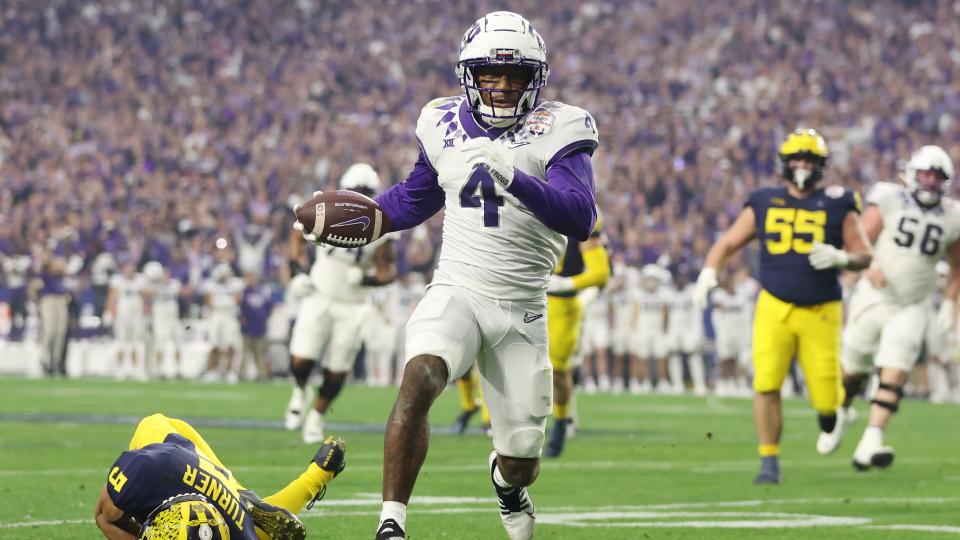
Do you know how many football national titles the Big Ten has won this century? That’s right, two. Out of twenty-three. Both by Ohio State, and no one else has really come close. In fact, to find the last consensus national title won by a founding member of the Big Ten that wasn’t Ohio State, you have to travel back to 1948. (Note Michigan State won in 1952, but the Spartans were not charter members and had to arm-wrestle their in-state rivals for admission. Always scared of real competition, those skunkbears.) This fact is even more remarkable given that the title was by media election, and most sportswriters seem overjoyed to carry the Big Ten’s bathwater for them.
The league has famously not won a national title in men’s basketball since the turn of the century, which is still more recently than their last women’s basketball national title. The conferences’ failures in hockey are maybe the most comical, where, despite having *three* programs with five or more titles, despite having multiple Final Four participants multiple years, the Big Ten has not won a title since it started sponsoring the sport. Baseball? Pretty much a non factor. No, the Big Ten’s claim to competitive success appears to begin and end with Iowa’s wrestling dynasty.
It’s telling that when Southern Cal joins the league next year, the Big Ten will be able to count double the national titles won by their programs this century. Rather than try to actually compete on the field, they’ve chosen to compete in the boardroom, adding strength by executive fiat rather than competitive results. They know they can’t compete nationally as themselves, so they add members from across the country to compensate. All under the pretense of “a bigger stage.” And how has that expansion gone for new members? Almost universally terribly. Penn State was a national power before accepting a Big Ten invite, and now boast the dubious distinction of being a solid second-tier program. Maryland men’s basketball has all but evaporated. And for your own safety, please don’t even look at Lincoln, Nebraska.
Yet somehow, conference leadership has convinced not one, but three prominent TV networks that this collection of mediocrity is worth $7 billion. With all due respect to the fine folks at Fox, CBS, and NBC, if someone has convinced you that Illinois-Indiana is worth paying millions of dollars each year for, you’ve been had.
And that’s not even getting into the academic side of things. The Big Ten is notorious for not considering schools that are not members of the Association of American University, an oligarchic group not of the schools that are best at teaching undergraduate students (which most college athletes are), but at who produces the most research. That’s a perfectly fine criteria to have if you want, but drawing a connection between research spending and the student-athlete experience is not a strong argument. Undergraduate education is a part of AAU membership, sure, but research output and graduate education are weighted far more heavily. The Big Ten is being deeply disingenuous when they tout this requirement as evidence of a better education for their football or basketball players.
Quick quiz — guess which Power 5 league (as of 2023) has the highest average rank on the US News and World Report rankings? (The flaws in these rankings are well-documented, but 90% of the reason they exist is to be used as ammunition in pointless arguments, so they’re being well-utilized here.) That’s right — it’s the ACC! Buoyed by schools like Duke, Virginia, North Carolina, Wake Forest, and Georgia Tech, the ACC is an academic powerhouse at least on par with the Big Ten and arguably exceeding it when it comes to educating undergraduates. (I even threw the BIG a bone and didn’t count Notre Dame in the ACC rankings, despite ND ranking higher than all BIG schools but Northwestern). The ACC has the nation’s first public university and the famed “Research Triangle” in North Carolina. Yet curiously, you very rarely hear the ACC thump its chest about academics, or insist that their members belong to an elite club of schools that spend a bunch of money on research. It’s almost like the ACC doesn’t need to make this a talking point, because the ACC doesn’t need to grasp at straws to justify an inflated media price tag.
If the Big Ten actually cared about their academic image, they would have invited Stanford and Cal a year ago. Instead, these two schools on the Pacific coast will go to the *Atlantic* Coast Conference, which will continue to be a stronger academic grouping than the Big Ten, even as the latter inflates itself with USC, UCLA, Oregon, and Washington. (I want to be clear here that I’m not knocking the education offered at any Big Ten school — they are all great schools. This is only to point out the puffery inherent to the Big Ten’s identity.) Instead, the Big Ten will use academics as a shield when convenient, while conveniently avoiding scrutiny of that talking point. They aren’t ahead of everyone else academically — not by a long shot.
The Big Ten is such a perfect example of the state of many modern American institutions. It’s a brand far more than it is a product. They have pretensions of grandeur they cannot match. They pretend to be better at sports than they actually are and better at academics than they actually are. They fail to deliver quality product, so they try to get ahead with money and buying up their rivals rather than improving who they are.
The Big Ten showed their true colors in the early twentieth century when they listened to a cheating, xenophobic football coach who couldn’t stand losing to a Catholic school and blacklisted Notre Dame, and they showed their true colors a hundred years later to kill a historic partner and make life immeasurably more difficult for countless West Coast college sports fans and students. They don’t care about academics or athletics — they care about their image.
They are the McMansions of college football. They are an Epcot version of the Ivy League and a matte painting of the SEC. And they have just extinguished any lingering doubt as to who the real villain of college sports is.
An empty brand buoyed by corporate cynicism and a legion of friendly sportswriters, far too many of whom attended institutions in the conference and drunk the Kool-Aid in immense quantities. That’s the Big Ten. It always has been.
And that’s the very same conference that is now spanning most of America, with the largest TV deal ever signed in college athletics. Lord help us all.
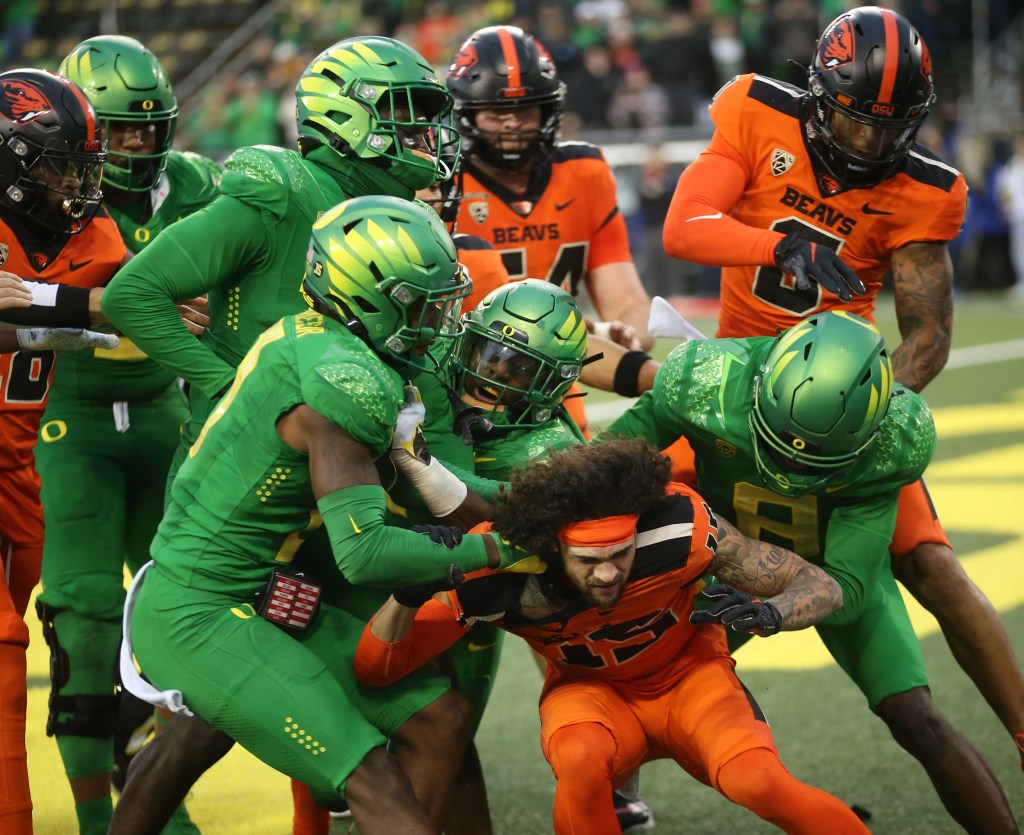
You also do have to marvel at the shortsightedness of it all.
No college football fans like this. Even the supposed “winners” of realignment are waking up to the fact that “winning” means cross-country flights to exotic locations like Piscataway and West Lafayette. They’re waking up to the fact that instead of playing for state dominance on Thanksgiving Weekend, they might be sitting snowed in on the tarmac at O’Hare, Steve Martin-style. College football fans are creatures of habit (this is a sport where sitting on your couch for twelve hours is not only welcomed, but encouraged), and saying this is a break in the routine is putting it mildly.
In no world is alienating your customer base good for business; but while say, insurance and drug companies who sell essential products may be able to get away with bad behavior, purveyors of entertainment absolutely can not. Keep pulling this crap, and the college football gravy train will quite quickly run off the rails.
There are three basic reasons for college football’s popularity, as I see it — its accessibility, its personality, and its stakes. College football is more accessible to more people than pro sports. A major-level college football team plays within a few hours’ drive at almost any point in the United States (sorry Alaska), while the NFL sticks to large cities. While college football tickets are hardly cheap, they’re much less of a burden than NFL tickets. The games air nearly constantly on fall Saturdays. But now, realignment threatens to make the game out of reach. If the goal is to create big matchups, what that does is drive up ticket prices and prevent fans from actually experiencing a college game in person. And as fun as couch sitting is, there’s nothing like a campus on a fall Saturday.
And that kind of personality, both in terms of the sport’s character and the sense that it is personable, that fuels college football. Fans feel a connection to their team, their fellow fans, and their school. Heck, from the way some folks in conferences talk, they apparently feel a connection to their opponents as well. Can we maintain these relationships across the country? On a wide scale? Are Oregon fans ever really gonna feel a fire in their belly to beat Wisconsin? They way they did Oregon State or Utah? Mangling the foundational structure of your product in the pursuit of a short-term payout is the administrative equivalent of Jenga — sure, your tower’s a little higher, but if it falls over as a result, what did anyone really gain here?
And all this frantic pursuit for TV money comes as that well looks increasingly like it’s going to dry up. You’ve seen the headlines — the streaming revolution has yet to turn a profit, as media companies invest billions into what appear more and more like money pits. Disney, yes Disney, is in the midst of dramatic spending cuts, including at ESPN. Oh, and there’s twin strikes going on in Hollywood that are threatening to delay the release of any new scripted content for months or years. Live sports, football especially, are the closest thing TV has to a sure thing, but how long are media companies going to be able and willing to cut giant checks as they lose money across their business? And, when they do, are they going to invest in college football?
There’s a glut of content these days, and it’s only going up as social media becomes more commonplace. Trying to watch everything is like trying to buy every item in a supermarket. There’s simply too much, so everyone has to concentrate on what’s meaningful to them in particular. It’s hard to see how a soulless, desiccated form of college football survives in that landscape.
The draw of college football is totally different than, say the NFL. Whereas the NFL’s key pitch is its parity, the draw of college football is its chaos. College football is wackiness, upsets, and endless debates to its core. But you can’t have chaos when there’s nothing predictable in the first place. All of a sudden when every game’s a big game no game is. The term “upset” doesn’t apply when the two teams look like they’re on equal footing.
Games like Sunday’s Florida State-LSU opener become footnotes, not features. These games don’t matter under a system where both teams likely make the playoff regardless of the result. The appeal of these games is that they have huge stakes for both teams — your whole season could be dashed in week 1. You don’t want to see USC-Ohio State every year. Big matchups between teams from across the country are big now because *they are rare.* Games like Notre Dame-USC are outliers for a reason — college fanbases are generally too provincial and niche for these kind of big games to work for more than a few times a year. It’s hard to ask even the larger fanbases to consistently turn out for these, between travel, tickets, and all the other costs that come with traveling for a big game. But one or two a year? Yeah, we can do that. But if USC and Ohio State become a fixture on each other’s schedules, suddenly it’s just any other game. You’d think college administrators in 2023 of all people would understand the principle of inflation, but hey, I don’t have a PhD.

Instead of maximizing the value of the product they have, college sports’ leaders have chosen to copy another product. If the value proposition of USC-Ohio State is teams from two of the fifteen largest cities in the United States playing a league game, what exactly is the difference between that and an NFL game?
The intention here is surely to capture some of the NFL audience & TV numbers, but the NFL is the greatest TV draw of all time. Going up against it is like jousting at a windmill. It’s such a massive television force that college football moves its major bowl and championship games from time slots that make sense for it to different, worse times (Monday night championship games are and will continue to be an affront to human decency). So why exactly college football thinks it can continue to make itself more like the NFL and thrive is beyond me.
“The NFL, but worse” is not a compelling sales pitch. College football is not, and cannot be, a knock-off pro league. This game thrives when it leans away from the pros, when it looks less tightly controlled, more authentic.
And by shifting this way, administrators risk alienating their core audience and making college football not just worse off as a product, but as a business. What college football fans look for in a sports product is different than what NFL fans look for, and by looking more like the latter, college teams will drive away the former. The net effect will be fewer college football fans and less money. How many people do you know who are die-hard fans of a minor league sports team?
By turning college football into a minor league NFL, the sport will die. Maybe not for a long time, maybe not in our lifetimes, but it will happen.
Now I’ll grant that many people follow college football as a way to stay connected with their alma mater. This is true, of course — and with a fanbase scattered across the country, Notre Dame might be the poster child for this. But will this continue to be true as the teams become increasingly disconnected from their schools? Will alumni still turn out for NC State or Auburn just because their school logo happens to be on the helmet? And if they do, will they be as passionate? If there’s a broad understanding that the college game is only a stepping stone to the pros, why should any of us continue to invest our time in it? It has to be meaningful in and of itself.
Which gets us, finally, to stakes. I am willing to bet money that for most college football fans, their favorite memories of the game are not a victory over a team from across a country. It’s beating a rival, ruining their season. It’s pulling an all-time upset over a familiar foe or staving one off by the skin of your teeth. They are epic clashes born out of the sense that that game, that game in particular, matters. There won’t be a rematch, or a do-over, or another shot down the line. There’s no mulligan. That’s it. The world disappears for three and a half hours and everything is contained in that five-acre stadium.
Gone is the magic of Duke beating Clemson on opening weekend and (seemingly) dashing the Tigers’ playoff hopes before the train even pulls out of the station. Gone is the feeling of relief felt by fans of a team that finally made a bowl game. Gone is the sense that every team, every year, can win something. These are the magic moments of college football, the reasons we keep coming back year after year. These small moments of personal victories, intensively meaningful to ourselves, coupled with a sense that they matter in the broader landscape. The chance to be a hero for a day. Instead, we’re headed straight for a world where these moments don’t matter, if they happen at all.
By running away from what makes the sport personal, the powers that be are running away from what makes the sport compelling. From what makes it meaningful. And we’ve got enough meaningless entertainment these days.
It’s been a weird, striking contrast, though, to witness these last two weeks of Notre Dame football, still standing upright like an ancient weathervane in the middle of a hurricane, seemingly completely unaffected by the maelstrom engulfing it.
For college football, a sport where everything around the game matters just as much if not more than the actual football, these two weekends represent what the sport could be at its highest aspiration. If football is the front porch of the university, Notre Dame opened its door to two very different, yet very enriching, opportunities the first two weeks of the season.
First up, of course, is our mini study abroad trip to Dublin. At times, the Fighting Irish shtick can get a little thin — I never quite got over the weirdness of saying “Go Irish” around actual Irish people. But for many in the Notre Dame community, this was a genuine occasion to connect with their ancestry and engage in the history and culture of another country. Notre Dame engages very deeply with the Emerald Isle in a way that many American universities, evidently, do not. Notre Dame students study at Irish universities year round. Notre Dame faculty build research and teaching partnerships with Irish faculty. The university maintains not one but two historic facilities on opposite sides of the country. It’s a remarkable level of commitment to a small country with a population smaller than that of the state of Indiana, even for a school branded as “the Fighting Irish.” The game was both a showcase for a lot of this work and a reminder that for as much emphasis as we put on college football, it is only one piece of a much bigger world. Yet even an ocean away, college football can still bring together friends and strangers alike.
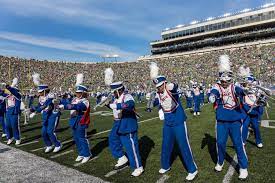
And then, for all the expected bruhaha among the fanbase for Notre Dame finally scheduling an FCS opponent, the university approached its first game with an HBCU with remarkable grace. In a number of subtle, yet clearly deliberate ways, Notre Dame ceded the spotlight to Tennessee State for the weekend. ND football weekends always include a bunch of academic accents, but there were more of them than usual this weekend — and all focused on Black and HBCU history. ND academic directors interviewed TSU leaders. ND coaches sat on a panel with Eddie George. The Grammy-award winning Aristocrat of Bands (kick-ass name, by the way) performed second at halftime, a spot traditionally reserved for the home team, and was spotlighted throughout the second half. It felt… humble. And I know that’s very easy for me to say as a white fan of a team that won 56-3 on Saturday, but it never seemed to me that ND acted as if it was doing TSU a favor. Notre Dame wanted to learn from Tennessee State.
Unfortunately, HBCUs rarely get a national showcase like this, and while no one should be under any illusions that a football game is going to solve systemic racism, it’s a helpful reminder that sports are always one of our most powerful conduits for social change. No, they don’t solve anything, but they are at their core communication platforms. Athletics — especially college athletics — can serve as inspiration and education. So yes, it absolutely matters that Notre Dame played an HBCU, just as it absolutely matters that the head coaches of three major sports at Notre Dame are Black. Notre Dame has a platform in athletics, and to the extent it can, it’s using it to amplify Black voices.
And, maybe most impressively, the ever image-conscious Notre Dame isn’t boasting about any of this — because, quite frankly, it shouldn’t. This should be the bare minimum. These aren’t radical changes — Notre Dame’s just making the most of an existing structure. There remains phenomenal amounts of work to do when it comes to racial justice at Notre Dame, which, despite a lot of positive momentum in increasing diversity among undergraduates, is still a thoroughly white place. Strictly in the athletic world, though, right now Notre Dame is walking the walk. That’s awesome to see.

Anyway, let’s cherish this last season before we truly jump the idiomatic shark next year. College football is always evolving, but it’s about to undergo it’s biggest mutation yet in 2024.
While I can’t say I feel good about where things are going, that’s all the more reason to appreciate what we have while we have it. We’ve already seen the delights this sport has to offer, including two of the most hateable coaches in America imploding in comical fashion on back-to-back nights. With the odds-on favorite to win it all staring down a hundred years of history that says they won’t, and the apparent decline of a few other recent powers, this has a lot of potential to be a fond farewell to the sport as we know it. To paraphrase Théoden, King of Rohan, if this is to be the end of college football, let us make such an end as to be worthy of remembrance.
With any luck, we’ll all remember 2023 as the last great season of college football. We’ll long for it always. It’ll remind us how college football is (or used to be) the greatest sport in the world. And maybe, just maybe, we’ll miss it enough it’ll help those in charge realize how much the new version sucks.
Maybe if it’s forever 2023 in our hearts, it may be 2023 in reality again.
– EC


 Emergency Caffeine
Leave a reply to Joseph Drey Cancel reply